HVAC owner. Mid-October. Fall season is on, the phone keeps ringing, the kitchen counter has become his desk because the office is full of his daughter’s birthday decorations. He’s been running quote-to-customer through AI for about six weeks. Tonight is quote one of the evening.
He pulls up the draft. Reads it.
Three things are off.
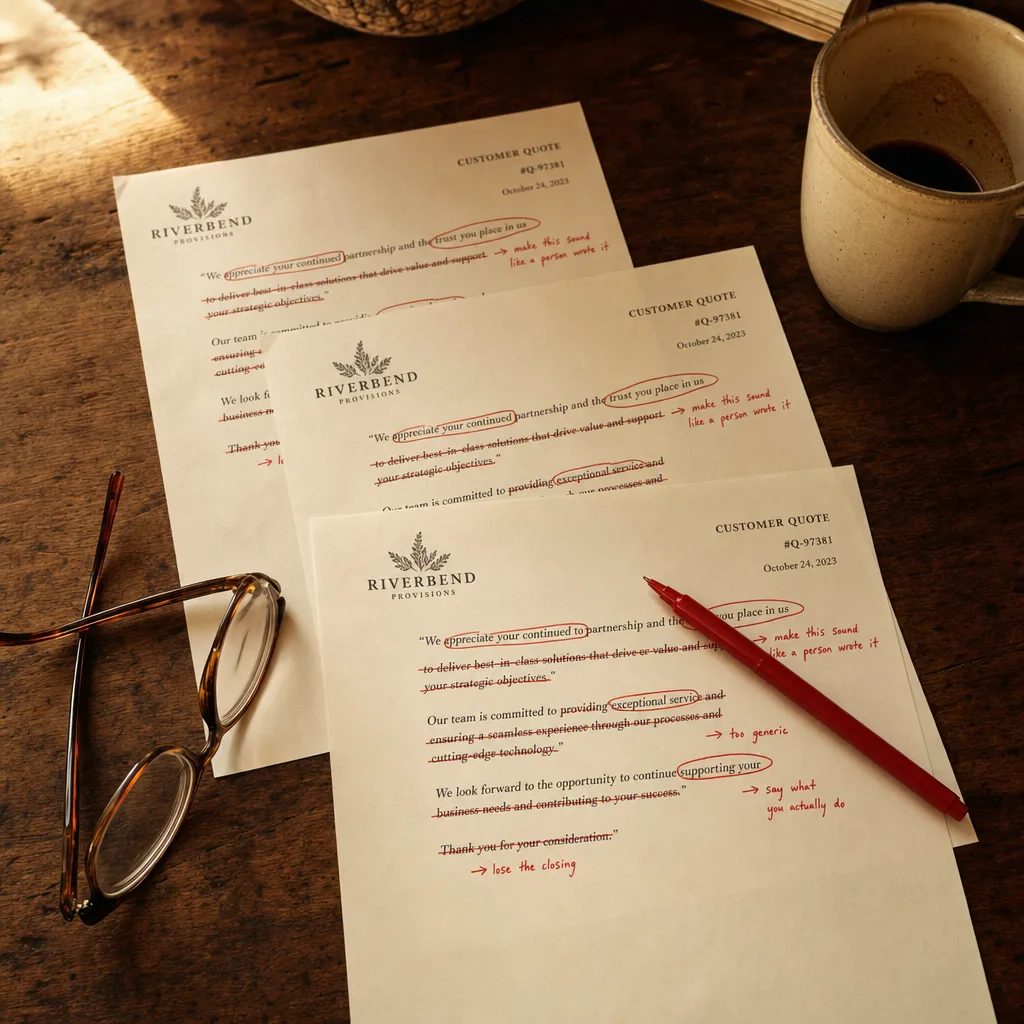
The tone is corporate, should be conversational. The financing language doesn’t match his actual contract terms. The scope format is wrong, sections in the wrong order, the warranty line buried.
He fixes all three. Forty-five minutes. Sends the quote. Pours another coffee.
Quote two arrives in his queue. He pulls up the draft. Reads it.
Same three things.
Tone, corporate. Financing language, wrong. Scope format, wrong order.
He fixes them again. Forty more minutes. Sends it. Stands up. Walks around the kitchen island. Sits back down.
Quote three.
“I gave it everything,” he tells me a week later. “Last year’s quotes. The contract terms. My pricing sheet. I don’t know what it’s missing. I keep fixing the same stuff.”
I asked him how many quotes he’d run through AI so far. He counted on his hand. Four. He said he hadn’t decided yet whether the tool worked.
Here’s the thing. He had decided. He’d been deciding, on every quote, for four straight quotes. He just hadn’t said it out loud yet.
What he was doing right
The HVAC owner was tasting and adjusting. That’s a real move.
The Four D’s name four stances the Chef takes on a given dish. DOING. DISPATCHING. DIALING. DECIDING. First drafts live at DIALING. The Chef reads the dish, names what’s off, makes the adjustment. The dish ships, the Chef moves to the next one.
He was at DIALING on quote one. Read the dish. Tone is corporate, financing language is wrong, scope format is buried. Three named adjustments. He made them. Dish shipped. By the rules of the stance, he did it right. Forty-five minutes is real time, but the adjustments were real adjustments, and quote one went out the door.
Most operators don’t even get to DIALING. They get the draft, see three things off, and collapse back to DOING. “I’ll just write it myself.” Ninety minutes of typing instead of forty-five of editing. The HVAC owner had moved past that failure. He was doing the editing job. That’s the part most operators skip.
This is the piece nobody gives him credit for. He was halfway up the ladder. He wasn’t going back down.
Where it went sideways
Then quote two came in. Same three fixes.
Here is where the stance question gets interesting.
The Chef who reads quote two and sees the same three things has a decision to make that the Four D’s don’t surface at the dish level. They surface at the recipe level. The dish is “this specific quote.” The recipe is “how AI writes our quotes.” DIALING on the dish means adjust this one. DIALING on the recipe means tell the system to stop making the adjustment necessary.
He stayed at the dish level. Fixed quote two. Sent it. Fixed quote three. Sent it. By quote four he was sitting at the kitchen counter wondering if AI worked.
Each individual edit was right. The problem isn’t the editing. The problem is editing the document instead of dialing the system.
The 20% he was doing was a craft job. Read this draft. Correct this draft. Send this draft. That’s the work of a senior operator doing senior operator work. He’s good at it. He’s been writing quotes for twenty years. Of course he’s good at it.
The 20% he was supposed to be doing was a setup job. Why does this draft keep needing the same three fixes? What does the system need to know so quote four doesn’t ask for them? Same effort. Different lever. The setup job costs fifteen minutes once. The craft job costs forty-five minutes every quote, forever, every fall, until either the season ends or he stops using the tool.
He was doing the part that needed him. He was just doing the wrong part.
The setup job vs. the craft job
Here’s the distinction I keep coming back to.
The 20% is yours. That part isn’t moving. The AI got you to 80, the 20 will always be a human’s job, that’s the whole shape of working with these tools.
But the 20% has two species. The craft job is make this dish right. The setup job is make the kitchen produce this dish right without me touching it again. Most operators recognize one and not the other. They’ve spent careers doing craft. They’ve never had a kitchen that could be set up to make the next dish less wrong. So when AI hands them an 80% draft, they reach for the tool they know. Edit the draft. “That’s my 20.”
Right. It is. The first time.
The second time the same three fixes show up, the work has just changed shape. Quote two isn’t asking for craft. Quote two is asking the Chef to step back, look at the recipe, and tighten the system. The HVAC owner was doing the work. He just wasn’t doing the work quote two was actually asking for.
“I gave it everything,” he told me. He had. Last year’s quotes. The contract terms. The pricing sheet. Everything he could think of, dumped in. What he hadn’t done was named the three things he kept fixing. The tone is supposed to sound like this. The financing language is supposed to read this way, in this order. The scope format goes warranty up top, services next, terms last. Three sentences in the system prompt. Fifteen minutes of his time. The kitchen never makes those three mistakes again.
I mean. Literally the kitchen never makes them again. That’s not metaphor.
The dish-level Chef is locked in DIALING on every dish, every time. The recipe-level Chef makes the dish-level Chef unnecessary on dimensions the recipe already handles. That’s the move quote two was waiting on. He missed it. He made it on quote three. He missed it on four. By the time we talked, he hadn’t named it yet, and the kitchen kept handing him quotes that needed the same forty-five minutes.
The grade trap
Yeah. There’s a second trap inside this one.
The HVAC owner had a feeling, by quote four, that AI wasn’t working. The feeling is true in the dish-level sense. He was editing every quote. The tool wasn’t saving him time. The feeling is false in the recipe-level sense. The tool was producing 80% draft on dimensions that had nothing to do with the three he was fixing. The structure was right. The technical content was right. The pricing math was right. The customer-name personalization was right. Eighty percent of every quote was clean.
He couldn’t see the eighty.
He could only see the twenty. The twenty was what he was touching. The twenty was where his hands were. The eighty was invisible because the eighty didn’t need him. That’s the whole point of the 80%. The part you don’t see is the part that’s working.
Operators do this with their teams, too. They see the things their people get wrong. They don’t see the things their people get right because right work doesn’t make noise. Right work just goes. The HVAC owner was grading the AI the way he grades a new hire. Watching the misses. Missing the rest. The conclusion lands the same way it always does. “This isn’t working.” What he meant was “the part I’m touching isn’t done yet.” Those are different sentences. He confused them.
What the recipe needed
Three sentences. That’s it. The kitchen needed three sentences from the Chef.
One. Quotes from this company sound like a conversation, not a corporate memo. Use contractions. Address the customer by first name. Keep paragraphs short. Read it like you’re talking, not writing. Two. Financing terms read like this exact paragraph, every time: [his actual language pasted in]. Don’t paraphrase, don’t summarize. Three. Section order goes warranty first, services and pricing second, contract terms last. Warranty up top builds trust before money shows up.
Three sentences. Fifteen minutes to write. Drop them in the system prompt or the project context. Generate quote five.
Quote five comes back. Different changes are needed. Maybe one this time, instead of three. Or different ones. Or none on those dimensions and one new one nobody had thought of yet. That’s the work the Four D’s expect from a Chef at DIALING. Read the new dish. Make the new adjustment. Update the system. Keep moving.
The point isn’t to stop editing. The point is to make sure the editing you do is on this draft, not on the absence of a system.
The Monday Move
Pull the last three documents you generated with AI and edited yourself. Pick one workflow. Quotes, proposals, emails to your team, recap notes from client calls, whatever’s been running.
List the changes you made on each one. Be specific. Not “fixed the tone” but “changed every ‘do not hesitate to contact’ to ‘just give me a call,’” not “fixed the scope” but “moved warranty to the top, removed the bullet list, broke the paragraph in half.” Real changes. Real before and after.
If the same three changes show up on all three documents, you’ve found the setup job.
Take fifteen minutes. Add those three things to the system prompt, the project context, the GPT instructions, whatever surface you’re working in. Be explicit. Don’t say “sound conversational.” Say “use contractions. Address the customer by first name. Keep paragraphs short.” Write it the way you’d write it to a new hire on day one. Specific. Concrete. Repeat-it-back specific.
Generate the fourth document. Time it.
The 20% should now be different changes, not the same ones. If they’re the same ones again, the setup is still wrong. That’s the next iteration. The system prompt is the recipe. The recipe gets dialed the same way a dish gets dialed.
If the 20% is genuinely different changes every time, now you’re at DIALING on the recipe. You’re working a level up. The dish-level Chef shows up only when the recipe-level Chef has earned a night off.
The HVAC owner ran the three-sentence setup the Monday after our call. Quote five had two small fixes, not three big ones. Quote six had none of the original three. He still edited. He just edited new things, and each edit was a sentence to a setup he was building. Two weeks in, he was spending eight to twelve minutes per quote. The dish-level work was gone. The recipe-level work had taken over.
The 20 stayed his. He just started doing the right 20.
So.
The 20 is your job. Make sure you’re doing the right 20.
The HVAC owner wasn’t doing AI wrong. He was doing it half right. The half he was doing was the craft half. The half he was missing was the setup half. Each edit was good. The pattern was the failure. The Four D’s say DIALING. They don’t say on what. The Chef has to pick.
If you’ve spent the last two weeks editing the same three things on every draft, you have already identified the setup. The system is waiting for you to write it down. Fifteen minutes. Three sentences. The kitchen stops asking.
That’s the 20 that was always yours. Go do it.
Original framework. Distilled from client work.
Framework spine: The Four D’s, DIALING stance. Read the full framework. Series: Acceptable Loss, Episode 3. Sister pieces: The (m)perfect Circle (Ep 1, the upstream tolerance argument) and Calculator Wrong vs. Writer Wrong (Ep 2, the deterministic-vs-probabilistic frame).
~ source material · Original framework. Distilled from client work.