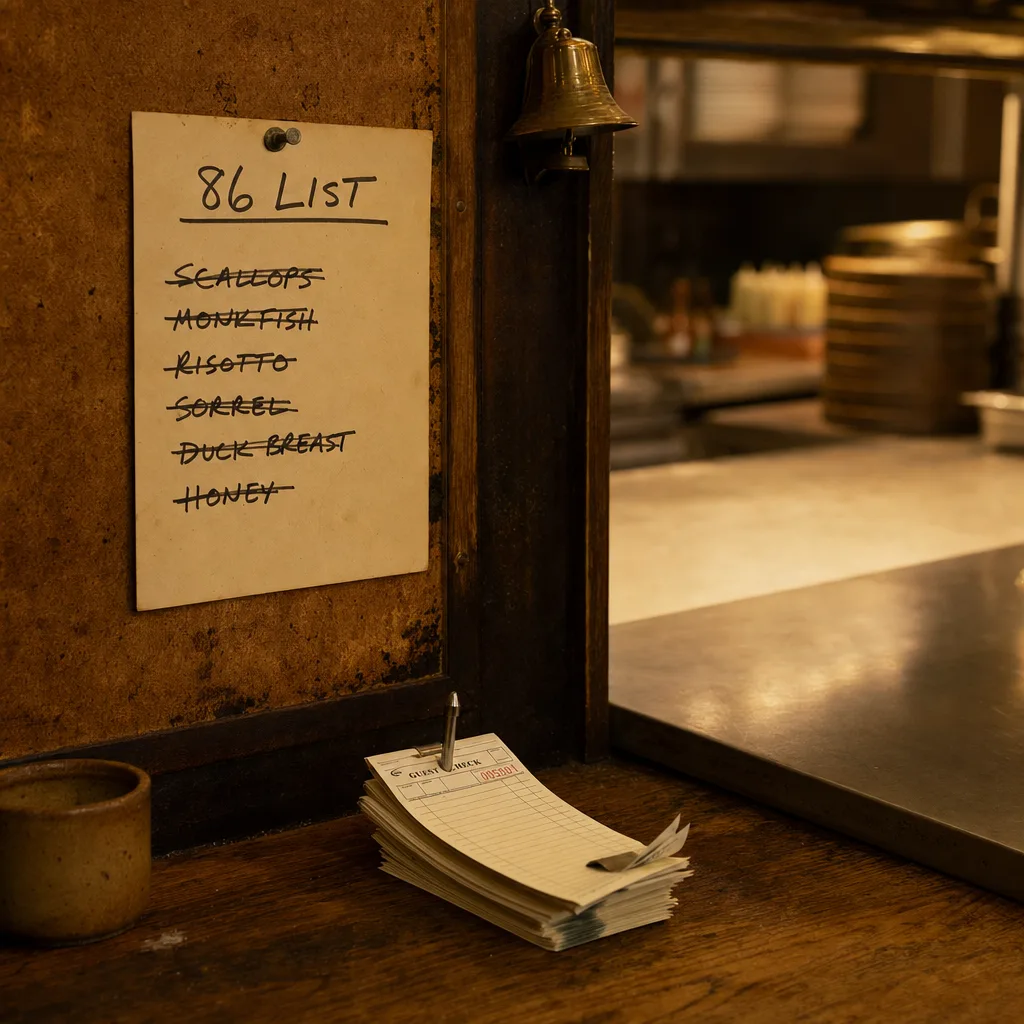
Walk into a serious restaurant kitchen on a Friday night. Look at the wall near the pass. Somewhere on it, handwritten, usually in a Sharpie, there’s a list of items that are 86’d. Off the menu. Not being served tonight. The list is short. It’s specific. It’s binding.
Nobody on the line plates an 86’d dish, no matter who orders it. The cook sees the ticket, glances at the wall, and either substitutes or sends a server out to renegotiate. No discussion. The list does the work.
Most operating businesses don’t have an 86 list.
They have a menu, sort of. Written down somewhere. Kind of. Maybe in a strategy doc from last year that nobody opens. Maybe in a slide from the all-hands in March. Maybe just in the owner’s head.
And they have everything else. Every initiative anyone has had in the last two years. Every pet project that didn’t get killed. Every AI experiment somebody announced in a Slack message and nobody ever buried. Every dashboard request from the VP of Sales that got built halfway and then sat. Every recurring meeting that everyone hates but nobody has canceled. Every Q3 planning artifact still treated as alive in May.
The kitchen is making all of it. Badly. Slowly. Without focus.
Here’s the thing. The Prep List framework already gives you a way to score what’s worth making. The Laziness Problem already tells you not to ship the half that doesn’t matter. This piece is one click earlier than either of those. Write down what you’ve actively decided not to make. Tell the team.
Half a strategy
Operators tend to think of strategy as the list of things they’re going to do.
That’s half a strategy.
The other half. The half that determines whether the first half actually happens. The list of things you’ve decided not to do. The no-list. The 86 list.
Without it, every initiative is technically alive. Technically alive means consuming oxygen. It shows up in meetings. It absorbs a minute of attention in the all-hands. It gets brought up by the team member who championed it eight months ago and would like a status update. The Chef has to deflect it gently every time, “yeah, we’re still figuring that out,” without ever saying out loud that the kitchen isn’t going to cook it.
Each individual deflection is cheap. The accumulation is brutal. Twelve technically-alive initiatives means twelve deflections a quarter. Means the team can’t tell what’s real and what’s pretend. Means new initiatives get added to the pile because adding is the only move the kitchen has ever named. The cuts have never been an option.
That’s not a strategy problem. That’s a no-list problem.
AI changed the price of indecision
The reason this matters more now than five years ago.
AI raised the price of leaving things technically alive. Five years ago, an undecided initiative cost the team five hours a month of low-grade ambient attention. Today, an undecided initiative can also be running. The AI experiment that got announced in February is literally still going, spinning up output nobody is reading, against a brief nobody refined, eating capacity in your tooling stack and your team’s monthly budget. The dashboard half-built last year is still pulling data, showing numbers to nobody, slowly drifting out of correctness.
Output used to be the bottleneck. The willing labor wasn’t there to make the half-decided dish. So the half-decided dish quietly died of neglect. That stopped being true.
Output is cheap now. The kitchen will happily make the dish. The dishes pile up on the pass. Nobody picks them up. They sit. Some of them get plated to nobody. Some of them spoil. All of them consume capacity the surviving menu actually needed.
The Laziness Problem covered what happens at the dish level. The Chef doesn’t define done, the kitchen produces and produces, and the office manager drowns in review. The no-list problem is one level up. The Chef doesn’t define not-done, and the kitchen burns capacity on dishes that were never going to be served.
Same dynamic. Different altitude.
The Prep List is for selection. The no-list is for closure.
The Prep List scores candidate systems on four dimensions. Repeatability. Volume. Definability. Reversibility. The score tells you what’s worth handing off to AI next. It’s a selection tool. Five candidates score, top one wins, work begins.
What happens to the bottom four?
In most operators’ practice, they stay candidates. They sit on the list. “We’ll get to those next quarter.” Next quarter, four new candidates show up. Now there are eight. Top one wins, seven sit. Two quarters later, the list is sixteen items deep and the team doesn’t know which ones are dead and which ones are sleeping.
The Prep List is supposed to be paired with the no-list. The top scorer goes forward. The bottom four go on the no-list. Explicitly. Named. With a sentence each on why we’re not doing this right now.
That’s the move most operators won’t make. Killing publicly is socially expensive. Somebody championed those four. Somebody pitched them in a leadership meeting in March. Somebody put a slide together. Burying them by name in writing costs political capital. The owner who built the company on relationships doesn’t want to be the one who tells the VP of Sales that her dashboard project is dead. “We’ll get to it” feels softer.
I mean. Right? That softness is the entire cost. The dashboard isn’t getting built. Saying “we’ll get to it” is the lie that lets the team keep working at it part-time on the assumption that it’s still real. The team is doing weeks of partial work on something the Chef has already decided to kill. The Chef just hasn’t told them.
The no-list is the Chef saying out loud what the room has already privately concluded.
Output Over Process, at a higher altitude
The Professional Recipe has seven ingredients. Ingredient #5 is Output Over Process. Define what useful enough looks like before what polished enough looks like.
The Laziness Problem is what happens when the Chef doesn’t do Ingredient #5 at the dish level. The kitchen produces, the operator drowns. The no-list is what happens when the Chef doesn’t do Ingredient #5 at the recipe level. The Chef defines done for a dish but doesn’t define not-done for the menu. The kitchen technically can make any dish, so the kitchen technically does, partially, on every alive initiative.
Same ingredient. One level up. The Chef has to do both.
Same discipline. Define useful enough lets the dish ship. Define not-done lets the menu ship. Most operators have the first half on their roadmap and don’t even see the second half exists.
The dish you’re not making is also a dish
There’s a subtle point inside this that I keep coming back to.
When a serious chef pulls a dish from the menu, it’s not a non-decision. It’s an active decision, with a sentence behind it. “We’re not running the duck tonight because the supplier’s birds came in light and the price doesn’t work for the plate.” The reason makes the dish dignified. The cooks don’t feel like the duck was an oversight. They feel like the chef made a call. The next night, when the birds are right, the duck comes back.
The undignified version is the dish that isn’t on the menu but the menu hasn’t said so. The cooks see the duck in the walk-in. “Are we running this tonight?” Nobody knows. The chef shrugs. “Maybe.” The duck sits another shift. Then another. By the third night, the duck is a problem.
The metaphor is exact. Your initiatives are the duck. Either they’re on the menu (and the kitchen makes them with focus) or they’re on the no-list (and the kitchen knows not to). Anything else is the duck in the walk-in. Costing capacity. Slowly going bad. The team checking on it on every shift to see if the chef has decided yet.
The no-list dignifies the cut. “We’re not building the renewals dashboard this year because we don’t have the volume to justify the build cost yet. We will revisit in Q1 next year when volume crosses X.” That’s a real sentence. The team knows where the dashboard sits. The VP who championed it knows what triggers reconsideration. The kitchen has its capacity back. Same energy that was going into half-building the dashboard goes into the dish the kitchen is actually running.
The Monday Move
Open a doc. Title it What we’re not doing.
List five things. Specific things. Not categories. Not “we’re not doing low-value initiatives.” Real items. Specific names. The renewals dashboard. The customer success automation pilot. The internal newsletter the VP of People floated in January. The AI agent for after-hours intake. The deck redesign that started in Q2 and stopped in Q3. Five items, by name, that have been pretending to be alive but haven’t moved in ninety days.
For each one, write one sentence. Not a paragraph. A sentence. “We are not doing this. Here’s why.” The sentence forces clarity. “We’re not doing the renewals dashboard because we don’t have the volume to justify the build cost.” Fifteen words. Done.
Send the doc to your team. Reference it in your next leadership meeting. Don’t soften the language. Don’t say “deprioritized.” Say “not doing.” The team can handle the truth. What they can’t handle is six months more of guessing.
The discomfort you feel sending the doc is the discomfort the kitchen has been carrying, distributed across everyone, the whole time. You’re not creating it by writing the no-list. You’re just naming where it’s been living.
Watch what happens in the two weeks after you send it.
The team will breathe out. The energy that was going into partial work on the five items will redirect. New initiatives will get proposed against an honest picture of capacity instead of a pretend one. The next Prep List will be cleaner because the no-list will be filling up beside it.
The cut is the strategy.
So.
Your menu is a wishlist. The cuts are the strategy.
Every kitchen worth eating in has an 86 list on the wall. Yours doesn’t, because you’ve been pretending the menu is the strategy. The menu is half the work. The cuts are what makes the menu real.
AI made the cost of not having a no-list visible for the first time. Five years ago you could leave initiatives technically alive and the lack of labor would quietly kill them. Now the labor is here. It’s free. It’s enthusiastic. It will happily make the dishes you forgot to bury. The bill comes due in capacity. The capacity bill is the one you don’t see until your surviving menu can’t get cooked because the dead dishes are still on the line.
Write the list. Name the cuts. Send the doc.
The kitchen knows.
Original framework. Distilled from client work.
Framework spine: The Prep List (selection) paired with The Professional Recipe, Ingredient #5: Output Over Process (closure). Read the Prep List and the Professional Recipe. Companion piece: The Laziness Problem (Output Over Process at the dish level). Sister piece in the same series: Hot Cross Buns (what the team gets to make while it learns; this piece is what the team doesn’t).
~ source material · Original framework. Distilled from client work.